Navigating the AI Renaissance: Welcome to the Age of Machine Creativity
Hey there, fellow tech enthusiasts! Buckle up, because today we’re diving headfirst into one of my favorite realms in the techaverse: Artificial Intelligence—in particular, how it’s making waves in the world of creative arts. Now, before you roll your eyes and mutter that you’ve heard this before, let me assure you—this is not your typical “AI is going to steal all art jobs” narrative. We’re going down a much more exciting, and ultimately optimistic, rabbit hole.
The Art of Machines: Meet the New Creatives
If you told me five years ago that computers would be producing Grammy-nominated music or exhibiting their own artwork, I’d have given you the same skeptical look my dog gives me when I ask her to do Algebra. Yet, here we are. The story of how AI has evolved from glorified calculators to budding artists is nothing short of fascinating.
Let’s talk about art—literally, paintings and sketches. Projects like OpenAI’s DALL-E and Google’s DeepArt are shaking up what we knew about creativity. You can throw a string of words like “mysterious cat detective solving crimes in a cyberpunk Tokyo” at DALL-E, and what comes back will genuinely blow your mind (and probably make you laugh a little).
Algorithms with Brushes
DeepArt takes it to another level by merging styles with real-world images. Fancy seeing your last vacation photo as a Van Gogh? Voilà, you got it. While these examples sound fun—and they are fun—they also open doors to serious discussions about the nature of creativity. Are machines mimicking creativity, or are we witnessing the birth of a new, non-human form of art?
Honestly, I think we’re looking at both. Machines enhance our creative process, acting as co-creators rather than replacers. They can translate vague human intentions into art forms that push the boundaries of imagination, inspiring us even further.
Music, Melodies, and Machine Harmonies
If visual arts are one realm, music is another altogether. Remember when AI-created tracks were mostly limited to dull, repetitive beats? That’s like calling the first wheel prototypes dated. Now we’ve got platforms like AIVA and Jukedeck composing entire albums, some of which are eerily beautiful.
They’re even impressing long-time music producers (and let me tell ya, impressing seasoned pros ain’t easy). Imagine having access to a tool that doesn’t just churn out royalty-free background music but understands emotional nuances, genre quirks, and can even tailor tracks based on your mood. Not to sound sci-fi or anything, but these stepping-stones might eventually lead to musical collaborations between humans and AI, much like how modern DJs use technology in their sets.
Bye-Bye Creativity Blocks?
For musicians, writers, and other creative types, facing the dreaded “blank page syndrome” is a rite of passage. Entering this new era, though, AI tools can serve as partners rather than solutions, giving a nudge or acting as brainstorming gadgets when the brain feels fried. It’s like having a creative buddy who’s hyper-efficient but never steals your snacks.
The Big Question: Will AI Replace Human Creativity?
The major concern floating around like an ominous cloud is about displacement. Are these burgeoning systems destined to outshine human creatives, sending us into the abyss of obsolescence? I’m planting both feet in the “no” camp on this one.
While AI can replicate and sometimes even expand upon human creativity, it doesn’t translate human experiences, emotions, or concepts drawn from our deeply personal perspectives.
A Future of Co-Creation
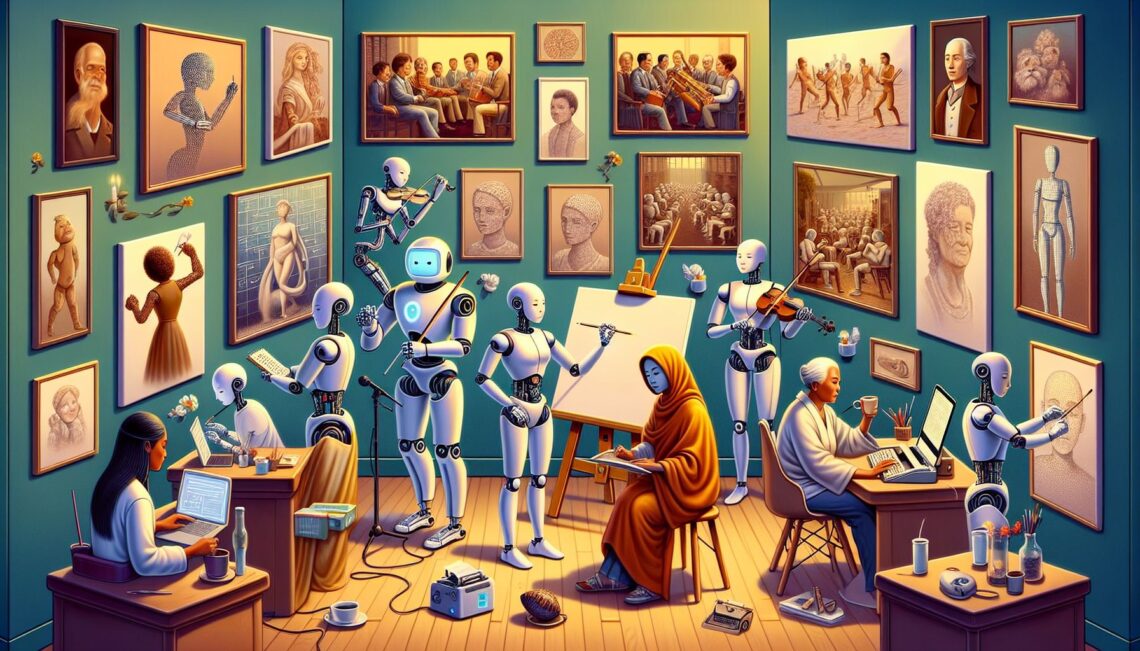
What’s eventually unfolding are narratives of co-creation, where human ingenuity meets computational prowess. Artists will find new muses, musicians will discover unheard rhythms, and authors will wander into unexplored storylines, all thanks to a delightful little assist from AI pals.
The Road Ahead: A Symphony of Human and Machine
What about the future, you ask? Without dipping too much into sci-fi territory, I foresee AI reshaping the definition of “job” in arts way differently than in industries like manufacturing. Here, the machine isn’t displacing the worker but forming part of an elaborate creative ecosystem.
Ethical and Practical Insights
But hold up—I’m not saying it’s all sunshine and rainbows. We still have ethical puzzles to crack. Who owns an AI-generated piece of art? How do we ensure these creations aren’t manifestation tools for harmful ideologies? These questions need thoughtful discourse, absolutely as they are pivotal to crafting frameworks which guide the ethics of creativity-assisted technology in the right direction.
Conclusion: The Infinite Canvas
The paint doors AI has opened are only glimpsing the horizon of what’s possible as we plunge further into this ongoing artistic transformation. Whether you view AI as an intrusive optimizer or a cool, quirky collaborator, one thing’s for sure—it’s got its virtual footprint firmly planted, ready to continue expanding the sandbox we play in.
So here’s to optimism, creativity, and a wild, weird future where man and machine both have a seat at the canvas. Who’s excited?!