The AI Revolution: Creative Arts in the Age of Machines
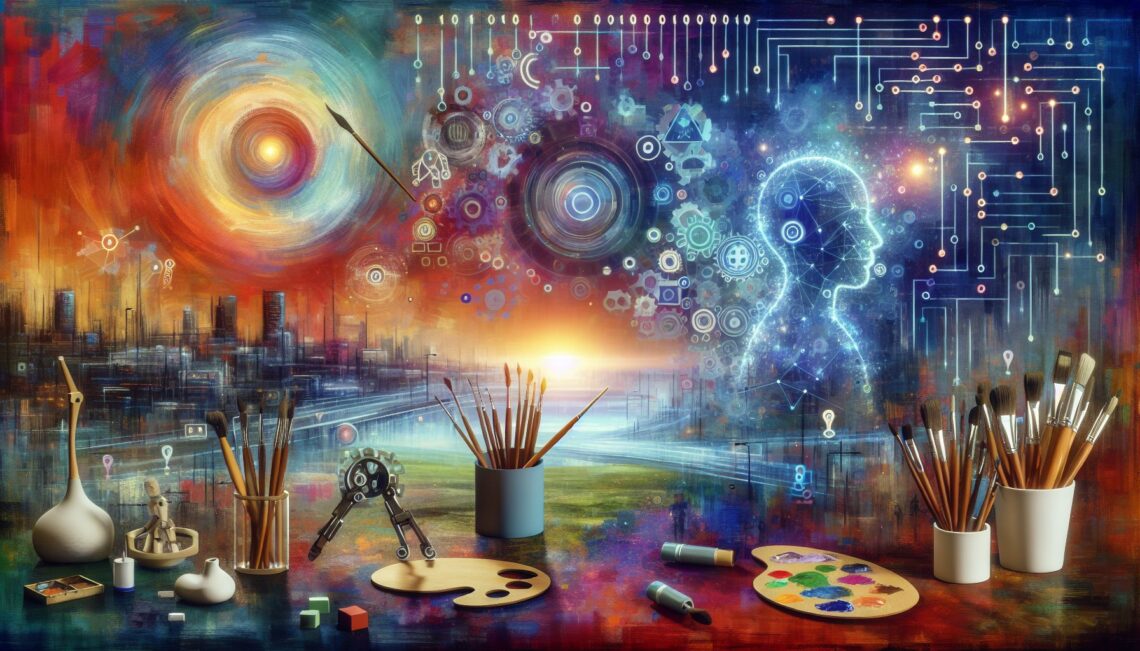
Hey there, fellow tech enthusiasts! Buckle up because today we’re diving into the mind-boggling world of Artificial Intelligence in creative arts. As someone who’s knee-deep in both the tech world and creative arts, I can’t wait to share why this is one of the most exciting intersections we’re witnessing right now.
Art in the Age of Algorithms
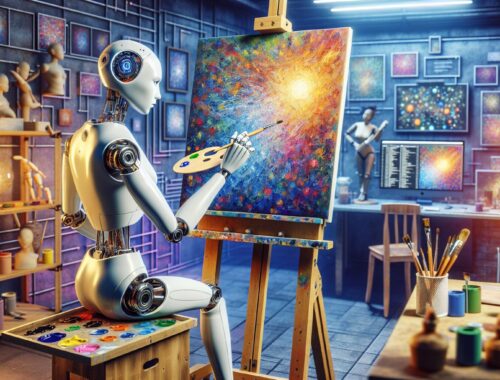
Remember when AI was all about calculating numbers and spotting cats in YouTube videos? Those were the good ol’ days of AI playing catch-up with the human brain. Well, say goodbye to merely identify everyday objects because AI has grown up and it’s wearing an artist’s hat now! Creative AI is revolutionizing the way we think about and create art.
Generative Deep Learning: The Picasso of Code
Generative models, particularly Generative Adversarial Networks (GANs), have taken the art world by storm. These models consist of two neural networks – yes, they come in pairs, like your favorite buddy cop movie. One network (the generator) creates an image from noise, while the other (the discriminator) evaluates it against real artwork, constantly pushing the generator to get better. It’s like having an ambitious art student and a snarky art critic as roommates, each forcing the other to reach new heights.
Ever heard of DeepArt, that app which turns selfies into stunning Van Gogh or Ukiyo-e styles? Yeah, that’s GANs flexing their muscles. These advances aren’t just limited to still images, either. AI is composing symphonies, crafting poetry, and even writing screenplays – and no, we’re not talking about replacing human artists. Instead, AI is becoming a new color on the human artist’s palette, offering avenues of expression we couldn’t even have imagined a decade ago.
Implications: The Good, the Bad, and the Beautiful
We can’t discuss this topic without tackling the implications—both awe-inspiring and admittedly, a tad controversial.
Democratizing Creativity
The baseline here is truly revolutionary: access. AI lowers the bar for creativity by offering tools that let anyone experiment with art forms, whether or not they have formal training. Want to compose music but never learned to read a single bar of sheet music? No problem. Applications that offer drag-and-drop interfaces to generate soundscapes are here for you. Fancy dabbling in digital painting? AI can offer layers of style transfer filters to get masterful results effortlessly. Welcome to the future where everyone has a shot at being an artist.
The Creativity Debate
Here’s where things get murky and deliciously human. The debate rages on: can AI be truly creative? Even Neural Networks rockstars like OpenAI and DeepMind admit they’re still chipping away at the mystery of creativity. If machine ‘creativity’ is just repurposing known styles and methods, are we actually witnessing creativity, or is it just highly advanced mimicry? While we ponder this existential question, let’s embrace what AI can do: serve as a muse, a collaborator, and a powerful tool to enhance and inspire human art.
Challenges: An Artist’s Work is Never Done
There’s immense potential here, but like with all super-powers, there’s also a catch—several of them, actually. Let’s look at a few challenges we face:
Ethical Concerns and Copyright Chaos
Imagine an AI pulls stylistic elements from, say, an iconic living artist and generates a work that’s eerily similar to theirs. Does it infringe on copyright laws? Should that AI art be credited to both the programmer and the datasets it was trained on? We’re wading into murky waters, my friends, and the art market’s legal landscape is scrambling to catch up.
The Possibility of AI Creative Monopolies
Not to sound apocalyptic, but tech companies are sitting on a treasure trove of AI capabilities, with the likes of Google and Facebook spearheading many of these advances. The worry here is that innovation becomes the playground of the few, leaving smaller entities and individual creators with fewer opportunities to get their hands on cutting-edge tools.
The Future: Scary? Magnificent? Definitely a Bit of Both
So, what does the future hold for AI in creative arts? Well, if we were looking for simple answers, we wouldn’t be on this journey at all, right? Here’s a curated glimpse:
Co-Creative Synergy
We’re moving towards an era where AI and humans form creative partnerships. Imagine a future where artists brainstorm ideas with an AI companion that offers creative prompts, or a visual artist uses AI to generate rough drafts that they can then refine. It’s the ultimate brainstorm, where your creative muse is a sentient machine.
New Art Forms
As AI pushes the boundaries, new forms of art will emerge—mind-blowing, multi-sensory experiences that leverage virtual and augmented realities combined with AI-driven narratives. Who’ll create the first AI art colony in space? Sure, it sounds far-fetched, but remember: AI making art was once an idea for sci-fi novels.
So there you have it! AI in creative arts is vast, thrilling, and topped with dollops of ethical quandaries. But isn’t that always the case with anything worth doing? Engage, debate, and—most importantly—create. That’s where the magic happens.
Now, I’d love to know how you see AI changing the creative landscape. Got a favorite AI art tool? Dreaming of AI compositions? Here’s me passing the mic.