The Dawn of AI in Creative Arts: The Brush Strokes of the Future
Hey there, fellow tech enthusiasts! 🤖 Today, I’m psyched to dive into something that’s been tickling the collective creative cortex of the art world: AI in creative arts. Yes, I know what you’re thinking—machines making art? Between writing code and chasing the next big startup idea, I didn’t think I’d witness the day when software would rival Van Gogh in painting or Picasso in creating abstract forms. But here we are, on the precipice of a revolution where silicon and creativity are colliding in ways that are as mesmerizing as they are mind-bending.
Art Meets Algorithms
Who would’ve thought that algorithms could doodle more than just graphs or solve complex equations? These days, they’re mixing pigments of ones and zeros to craft masterpieces. The likes of DeepArt and Google’s DeepDream have opened Pandora’s paintbox, showing us that artificial intelligence isn’t just about playing Go or piloting Teslas—it’s got a softer, more brush-and-canvas side too.
The Rise of the Machines… and Brushes
Remember that time when AI beat a human at chess? Now, imagine if that AI decided to paint its own version of the victory moment—on a canvas. That’s roughly what happened at the auction houses in 2018 when an AI-generated portrait sold for an eye-popping $432,500! Created by a model called GANs (Generative Adversarial Networks), this piece was like a digital dialogue between two neural networks: one creating realistic images, the other critiquing them. It’s fascinating, watching these digital critiques get gradually better at visual storytelling.
A New Art Renaissance?
I like to think of this as a renaissance where the artist’s palette isn’t limited by human hands anymore. We’ve got AI compadres like OpenAI’s DALL-E weaving visual wonders from simple text prompts. Imagine typing “a surrealist painting of a cat on Mars” and moments later getting a vibrant, professionally composed image that’s sure to be a hit on social media. AI in creative arts isn’t just dabbling—it’s doodling entire worlds.
Opportunities for Artists
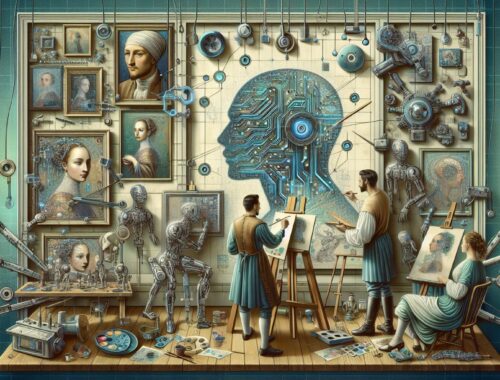
Now, before the artists out there start preparing their torches and pitchforks (or should I say, brushes and palettes?), let’s clarify something: AI isn’t taking over; it’s teaming up. Think of AI as a collaborative artist’s assistant, one that’s tireless, brimming with fresh perspectives, and not too bad at fetching coffee either (metaphorically speaking, that is).
Artists are leveraging AI to break down creative barriers and achieve innovative results. It’s a beautiful mashup of human intuition and machine learning. Imagine having AI as a partner that suggests novel colors you might’ve overlooked, or styles that push the boundaries of your current technique.
To Infinity and Beyond… But Also to the Critics
A technophile’s dream might be a techno-critic’s nightmare. Let’s be real here: not everyone’s a fan of machines playing Picasso. Questions about authenticity and originality loom large. Because if a machine-generated artwork holds an audience spellbound, then what exactly does that say about the human touch?
The Debate: Artistry or Automation?
Sure, the human touch contains centuries of cultural context and personal perspective—something that doesn’t inherently exist in formula-driven outputs. But! (And here’s where I’d usually insert a digital drumroll), could it be that AI is augmenting our perception of creative expression, allowing us to find beauty in unexpected algorithmic places? There’s an ongoing conversation about the soul of art and whether a machine can possess, or creatively mimic it. Personally, I like to think that far from replacing artists, AI is opening up a new spectrum of what art can be.
Onwards into the Future
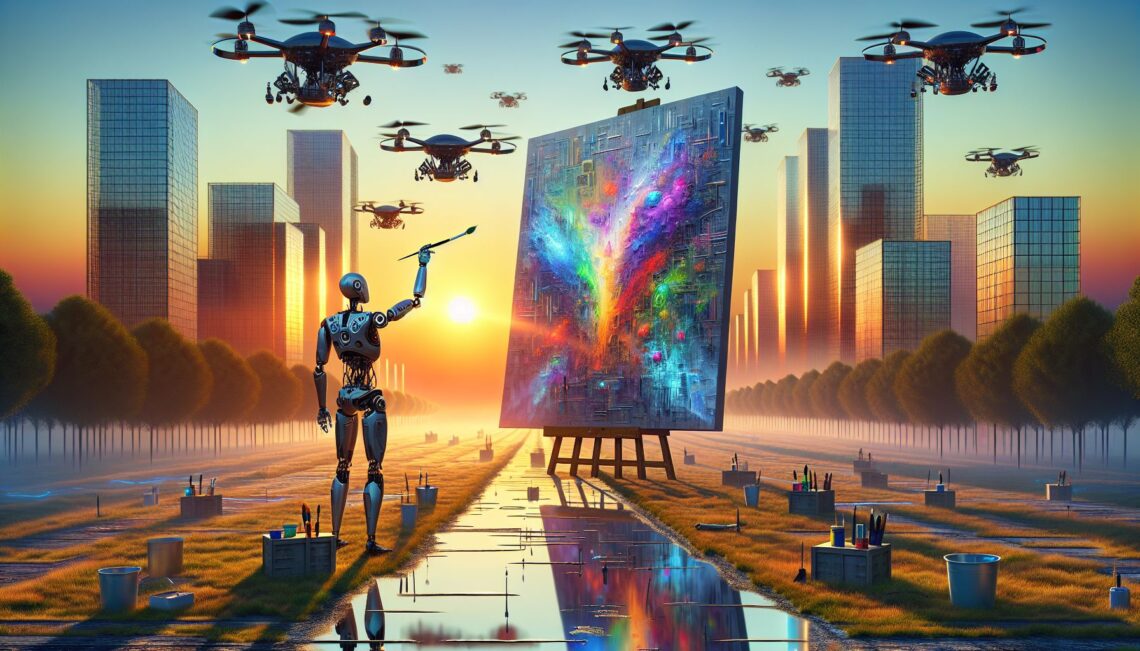
So, what does the art world look like in a decade or two from now? Only time (and some very smart neural networks) will tell. While I don’t have a crystal ball (hint: if you know how to program one, I’m interested), I bet we’ll see AI becoming a medium in itself, where programmers are the poets teaching machines the language of art. Maybe artists won’t just be wielding brushes but also vast datasets, pushing creativity into new dimensions.
Collaboration with AI might become as pervasive as paint in the creative process. It’ll be like having R2-D2 assist Michelangelo: head-spinningly futuristic, but utterly fascinating. Who’s ready for the gallery exhibit where every piece feels like a co-creation between a human and an AI? I know I am!
So here’s to this techno-utopian future, where creativity is a universal language shared by humans and machines alike, one pixelated brushstroke at a time. Let the art and algorithms dance, people!
And that’s the scoop from my tech-illuminated desk today. Until next time—leave your thoughts in the comments, especially if you envisage yourself forging collaborations with AI in your next creative venture. Happy creating! 🌟