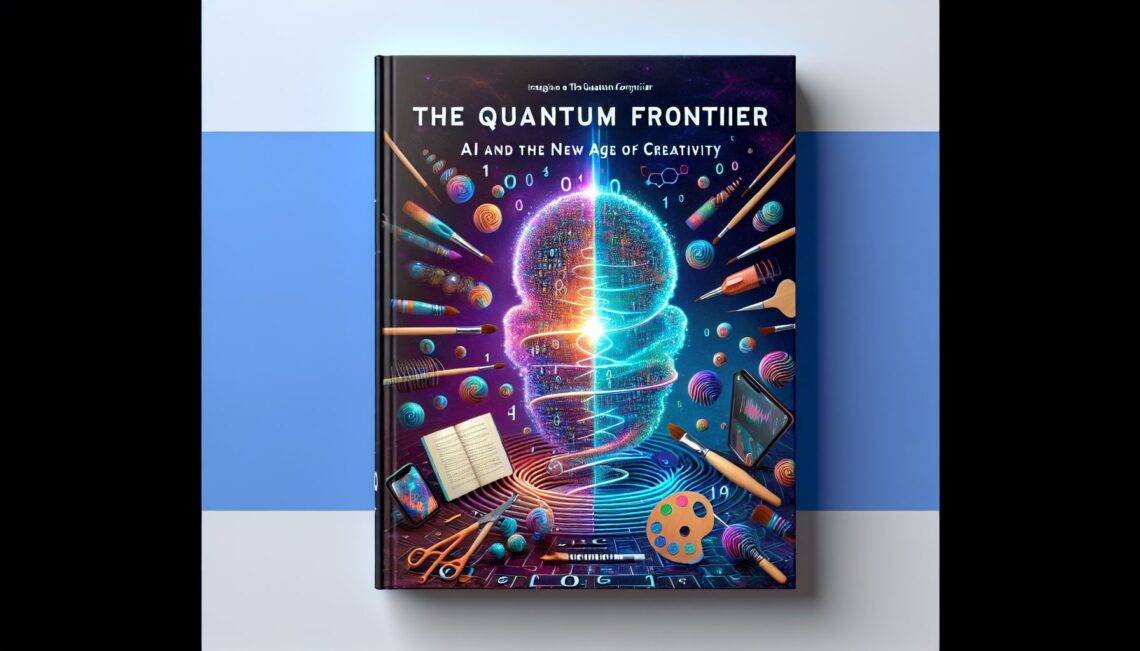
The Quantum Frontier: AI and the New Age of Creativity
Hey there, fellow tech enthusiasts! Today, I’m diving headfirst into a topic that’s got my circuits buzzing with excitement – Artificial Intelligence and its mind-blowing breakthrough in the realm of the creative arts. You’ve heard of fintech revolutions and the age of robotics, but AI is now painting, writing, and composing music. Wild, right? It’s like letting creativity go on autopilot, and I promise it’s as thrilling as it sounds.
The Rise of Creative Machines: AI in Art
Let’s kick things off with a splash of color on the canvas. Remember when AI was just all about beating humans at chess or solving mind-boggling equations faster than we could even say “parallel processing”? Well, those days are behind us. AI is now breaking into the art world like a rock star smashing a guitar – only more elegantly.
Artists around the globe are adopting AI as their muse and co-creator. Take, for instance, the famous Generative Adversarial Networks (GANs). These bad boys can generate artwork that’s not only unique but often breathtakingly beautiful! It’s as if we’ve unleashed a Picasso-bot into the digital realm. There’s a piece called “Edmond de Belamy,” created by a Parisian art collective using GANs, that sold at Christie’s for a cool $432,500. Art isn’t dying; it’s just getting a massive digital upgrade!
AI: The Wordsmith Extraordinaire
Now, let’s switch gears to a realm near and dear to my heart – writing. With AI, the blank page is not such a terrifying beast anymore. Natural Language Processing (NLP) models like GPT (Generative Pre-trained Transformer) are spinning text in ways that would make Shakespeare raise an eyebrow or two.
These models can generate blog posts, script screenplays, and even write poetry that can tug at the heartstrings of even the most stoic readers. The best part? It doesn’t take coffee breaks (though I’d still argue it needs an upgrade on humor). The implications here are vast. Imagine journalists using AI counterparts to break down data-heavy reports or novelists using AI to brainstorm plot twists. It’s like unlocking the ultimate writer’s room!
Musical Maestro: AI in Music Composition
As they say, where words fail, music speaks. And now, AI’s chiming in on the melody. AI-powered tools are composing symphonies and remixing tracks at warp speed. Platforms like OpenAI’s Jukebox generate songs in different genres and styles, producing results you’d swear were created by human hands.
Imagine AI-supported music composition as an infinite creative playground. Musicians can feed these networks a few notes, and like magic, they get a full orchestration ready to impress. While purists might argue it lacks the soulful undertones of human-created music, the potential for collaboration between humans and machines is limitless. AI is like the ultimate jam buddy, always ready with fresh tunes.
The Jungles of Creativity: Navigating the Philosophical Landscape
Now, let’s not get too lost in the digital dazzle – we need to address the elephant in the room: what does this mean for traditional art, literature, and music? There’s a juicy philosophical debate simmering around whether AI can truly “create” art in the human sense.
Creativity has always been about expression, a window into the human soul, if you will. But here’s a counterpoint – maybe AI can help us explore new dimensions of creativity by enabling humans to push the boundaries of what’s possible. Think of it as a new medium, like when we transitioned from acoustic to electric guitars. The fear that machines might replace human artists feels remote because, let’s face it, machines still can’t feel. They’re fantastic tools, but we’re the ones who wield them.
Learning to Dance with AI
Right about now, you might be thinking about how one can get in on this AI action. It’s simpler than you’d think! Whether you’re an artist, writer, or composer, adding AI to your toolkit can be a powerful enhancement to your work. There are plenty of platforms and open-source software out there trying to democratize access to AI for creative purposes.
It’s like taming a wild horse for the first time – exhilarating, unpredictable, but absolutely worth it once you hit your stride. Commit to a bit of experimentation, and you just might discover a new creative angle or entire genre no one’s even thought of before. Don’t be afraid to push those boundaries – it’s 2023, and if the metaverse has taught us anything, it’s that boundaries are often more malleable than we think.
The Future Outlook: AI, Creativity, and Us
So where’s all this leading us? Here’s where we throw on our futuristic goggles and speculate a little. AI’s role in the arts is only going to grow. As algorithms become more sophisticated, we’ll see even more seamless integration into various creative processes. And who knows? Maybe one day we can credit AI with creating an entire artistic movement. The new renaissance, anyone?
Ultimately, the future is collaborative. The line between human and machine-made will blur, creating an art form that will forever change how we perceive creativity and expression. Fasten your seatbelts, folks – AI’s creative revolution is just getting started!
In conclusion, whether you’re a die-hard traditionalist or a techie who’s all about that #DigitalLife, one thing’s for certain – we’re living in fascinating times. Our creative potential is vast and with technology as our ally, the possibilities are endless. Now, excuse me while I teach my AI how to juggle code and paint a masterpiece at the same time. Who knew the future could be so arty?
Catch you in the next post! 🎨🚀