The Quantum Leap: AI’s Role in Creative Arts
Hey there, fellow tech enthusiasts! Today, I’m diving into a topic that’s sparking way more than just my curiosity – it’s lighting up the imaginations of creatives and techies alike: Artificial Intelligence in the creative arts. 😎
Now, I know what you’re thinking. “AI and creativity? Aren’t those like oil and water?” Well, stick with me, and let’s explore how AI is not just dipping its toes into the artistic pool but doing a full-on cannonball!
A Brush with AI
Let’s start with a fun little anecdote. Just last year, I was at an art exhibit showcasing AI-generated paintings. Imagine my surprise when one of the pieces—a vibrant mash of colors and forms—reminded me of a summer spent backpacking across Europe. Now, was this just a stroke of genius by an algorithm? Who knows! But what’s clear is that AI isn’t just doing what it’s told; it’s making us feel something.
AI: The Apprentice or the Artist?
So, how does this all work? In its simplest form, AI in art is often powered by Generative Adversarial Networks (GANs). For the uninitiated, think of GANs like a pair of artists. One creates, while the other critiques, honing the masterpiece to perfection. It’s a digital dance of creation and refinement.
But it’s not just about machines churning out pretty pictures. Artists are using AI as a tool for augmenting their creativity. Take the story of Refik Anadol, who uses AI to transform urban data into mesmerizing visual art. Like a true creative partner, AI is stepping in where traditional methods reach their limits, offering a fresh palette of possibilities.
AI: From Muse to Master
Can machines truly be creative? Let’s toss that philosophical hot potato for a moment because what matters now is that AI is opening doors. Consider projects like OpenAI’s DALL-E, which can generate impressively surreal images from textual prompts. Or the AI Muse project, pairing poets and AIs to create stunning verse. It’s like giving our imagination a sidekick—one that never tires and always has a suggestion.
The Canvas of Code: Under the Hood
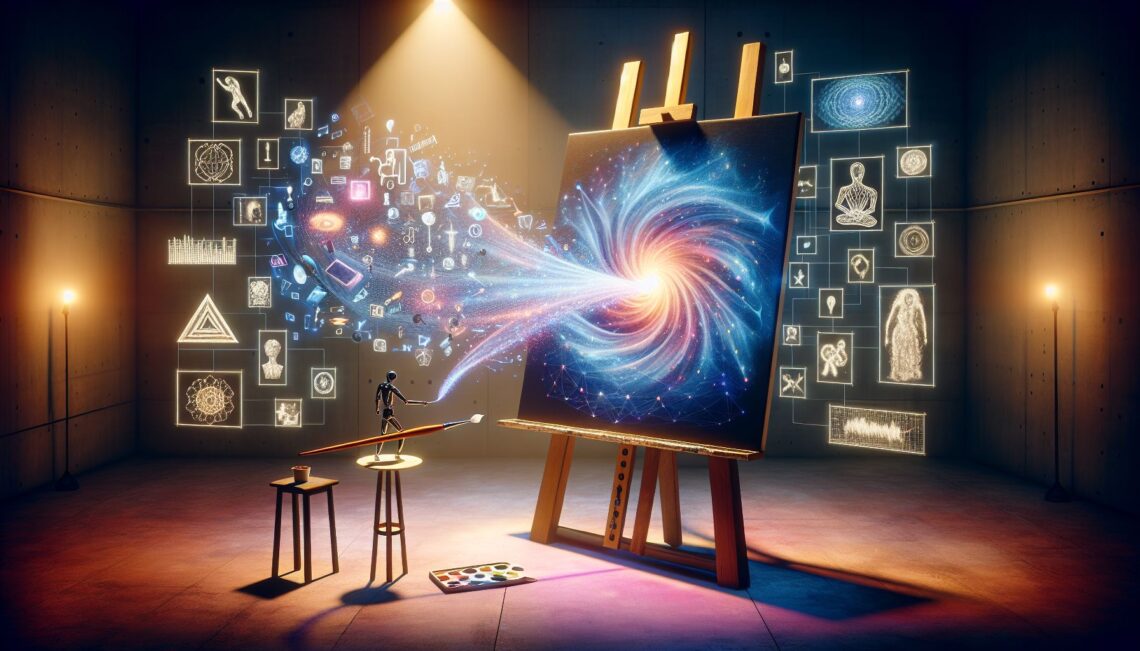
Diving a bit deeper, let’s break down how this happens. Algorithms parse through heaps of data, learning styles, techniques, and contexts. This data-driven learning is AI’s secret sauce, allowing it to paint, compose, and write with unexpected flair.
Neural Networks in Neon
I promise this isn’t a sci-fi movie. Neural networks might sound like jargon, but they’re basically the brain behind AI. They mimic how we humans learn. By feeding these networks millions of images, sounds, and texts, they start to ‘understand’ and ‘create’ art. It’s akin to an art student studying centuries of paintings before attempting their original work.
From Code to Creativity
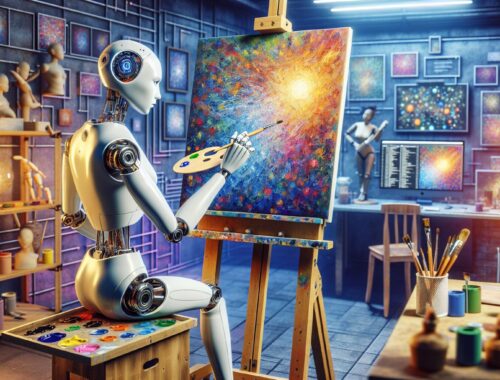
Even if AI isn’t wearing a beret and holding a paintbrush, it’s injecting a new dimension into the arts. Algorithms can sift through centuries of styles and methods, producing ‘art’ that’s not just a random swirl of pixels but creations that feel intentional and inspired.
The Avant-garde of AI: Challenges & Criticisms
Naturally, this leap forward brings its own set of questions—ones that we can’t ignore. Who owns AI-generated art? Is it the developer, the operator, or the AI itself? Intellectual property laws, already complex, are playing catch-up. Not to mention, there’s the thorny issue of AI potentially becoming derivative or lacking that uniquely human touch.
Yet, like every grand innovation, these challenges inspire dialogue and development. It’s not about machines taking over; it’s about humans steering the course, leveraging technology to push creative boundaries.
Speculating on Tomorrow: AI’s Artistic Future
Alright, time to dust off the crystal ball and do a little prognosticating. AI’s role in the creative arts is only just beginning. Picture a future where your home’s digital assistant doesn’t just manage your calendar but also curates personalized music playlists or even composes pieces in styles that resonate with you.
Imagine AI guiding virtual museums, offering interactive tours infused with emotional and historical insights. Or picture AI collaborating live in performances, cocreating with humans in ways we’re only beginning to fathom.
In the world of art education, AI could personalize learning experiences, adapting techniques and focus areas in real-time to nurture budding artists’ unique talents. It could democratize access to creative resources, making learning more inclusive and widespread than ever before.
Closing Brushstrokes
So, here we stand on the precipice of something truly exciting. AI isn’t just a flash in the tech-pan; it’s becoming an integral node in our creative network. As with any partnership, it’s about balance—using AI to amplify our artistry while ensuring the human touch doesn’t get lost in the code.
Next time you encounter an AI artwork, take a moment to engage with it. You might find it evokes something unexpected. Art, after all, has always been about breaking norms and exploring novelties. And who knows, the next Van Gogh could very well be a savvy coder with a flair for AI development.
Until next time, stay curious, keep creating—whether on canvas or in code—and remember, the future’s not just what we create; it’s how we choose to shape it. Let’s make sure it’s a masterpiece. 🎨