Welcome to the Age of Techno-Utopia: Exploring the Art of AI in the Creative World
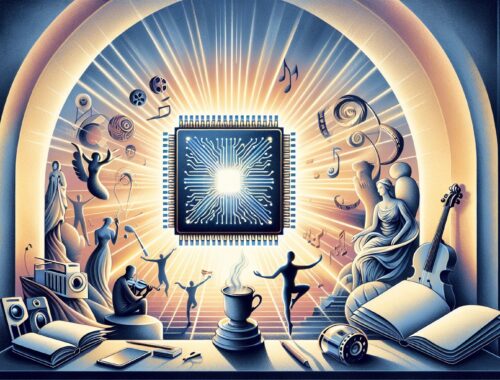
Hey there, fellow tech enthusiasts! Ever found yourself daydreaming about a future where artificial intelligence not only does your homework but paints your walls or even writes a hit single for you? Well, strap in because we’re diving into the dazzling world where AI meets creative arts—a place where the lines between human ingenuity and machine intelligence blur in the best possible way.
The AI Symphony Begins
Imagine this: you wake up to an orchestral piece composed overnight, just for you, by an AI. That’s not just a futuristic fantasy anymore; it’s today’s reality (cue dramatic movie trailer voice).
Recent advancements have turned AI into our very own digital Beethoven. Take OpenAI’s MuseNet for example. This astounding tool can compose classical symphonies, catchy tunes, or even experimental jazz, seemingly out of thin air. At first, it might sound like robots taking over music, but don’t start packing for Mars just yet. This is only scratching the surface of possibility.
AI: The Modern Van Gogh?
While some folks were busy musing over whether computers would ever develop taste, AI’s quietly been learning to paint. Picture an AI program immersing itself in the most complex neural networks to produce images good enough to hang on walls—that’s the power of generative adversarial networks (GANs). These two networks learn in tandem, one creating images and the other critiquing until the art reaches a level worthy of human awe.
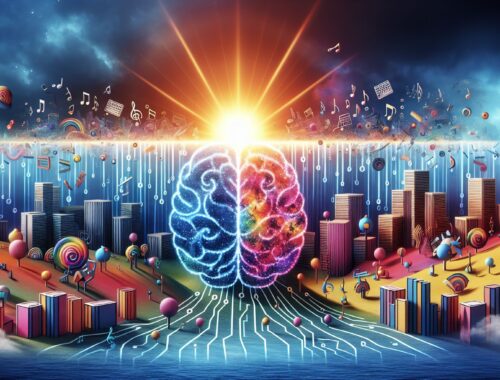
Remember the first time you saw something beautiful and couldn’t quite describe why? That’s what the AI art pieces can evoke. Creativity is becoming an exciting collaboration between human intuition and machine calculation.
Why AI in Creative Arts is a Game-Changer
The impact of AI in creative arts is far from trivial—it’s revolutionary. For one, it democratizes creativity. You don’t have to be Pablo Picasso or Mozart to get involved. The toolbox of an artist is expanding, with AI as the new, intriguing brush.
Encouraging Newcomers
For anyone who’s struggled to sketch a circle, AI offers a safety net. It allows budding artists to experiment and learn from the machine’s suggestions, effectively becoming their personal, never-tiring mentor. Imagine remixing your favorite song with the touch of a button or redesigning your room’s layout with AI-driven interior design software. It’s like turning the world into your creative oyster.
Speed and Efficiency
Then there’s the speed factor. AI’s capacity to process information makes traditional art creation methods look like dial-up internet. Need a poster for the new gig you’re hosting? Minutes. Want a storyline for your novel? Seconds. It’s like having a team of caffeinated creative minds working around the clock.
The Elegance of Collaboration
It’s tempting to view AI as the reigning master of the arts, but the true magic lies in collaboration. The human touch is irreplaceable; it tempers AI’s algorithmic precision with emotional depth.
Human Touch Meets Machine Precision
AI drafts, humans revise. AI suggests chord progressions, humans add the soul. Together, they’re creating a new artistic dialect. This relationship doesn’t threaten human creativity; it nurtures and amplifies it. The Michelangelo of tomorrow isn’t a lone figure sculpting a statue—it’s a hybrid effort blending digital sophistication with human passion.
Challenges: What’s Next on the Canvas?
Of course, there’s turbulence at every budding frontier. The question on everyone’s mind: Are we headed to a world where creativity is mere algorithms?
Ethical Considerations
We must navigate ethical concerns—who owns AI-generated art? Can AI have copyright? Questions like these need answers as we continue embedding AI deeper into the arts.
Quality vs. Quantity
Flooding the market with infinite creations can overwhelm traditional gatekeeping mechanisms. Evaluating quality becomes tougher when there are gazillion AI-crafted versions of “The Starry Night.”
Speculating Into the Future
What’s next for this dance of human and AI creativity? The possibilities are both thrilling and abundant. I can imagine a future gallery showcasing collections where AI and human creations sit side-by-side, indistinguishable and complementary.
Artists in the making, whether young or old, may soon have virtual collaborations with legendary figures like Da Vinci or Amy Winehouse, through holograms or other yet-to-be-invented technologies. We’re making creativity limitless, just by tweaking a few lines of code.
Conclusion: A Symphony of Prospects
With AI in the creative arts, we’re not just producing art; we’re reinventing what it means to create and appreciate. Instead of fearing a dystopian future where machines strip away our creativity, let’s embrace the idea of them as co-contributors to humanity’s tapestry of wonders. After all, they don’t need to sleep, and as far as we know, they’ve never run out of coffee.
The next time you hear a stunning classical piece or gaze upon an unexpectedly moving work of art, give it a thought—AI might have had a hand in it. There’s a latent artist in every one of us, waiting to make a splash in this new techno-utopian canvas of possibilities.
Stay curious, and keep pushing the boundaries of what creativity can be. Until next time, keep dreaming and let that digital paintbrush run wild!