Welcome to the Age of Infinite Creativity: AI in the Creative Arts
Hey there, fellow tech enthusiasts and curious minds! If you’ve clicked your way here, then you’re in for a treat today as we dive into the exhilarating world of Artificial Intelligence (AI) in the realm of creative arts. Grab your favorite caffeinated beverage, kick back, and let’s explore this brave new world where AI-generated masterpieces are becoming the talk of the tech town.
The New Renaissance: AI’s Creative Leap
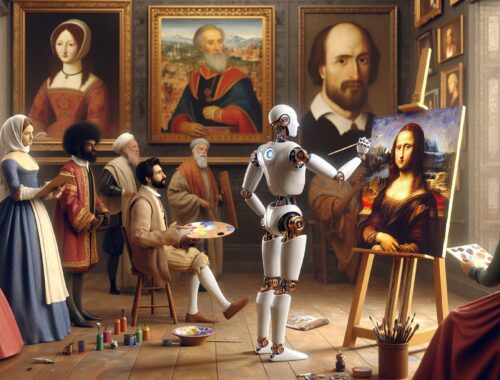
Let’s be real for a moment: the idea of machines creating art was once the stuff of science fiction. Fast forward to 2023, and not only is AI crafting art, it’s redefining what it means to be an artist. In a modern twist on the Renaissance, AI systems have begun generating music, illustrations, and even movies. And while some might say that this bots-versus-humans narrative is terrifying, I like to think of it as a new chapter in the endless story of creativity.
Machine Learning, the Muse of the Future
Consider this: the algorithms that power AI are like eager apprentices, diligently learning from vast datasets of existing artworks. These algorithms discern patterns and styles, and then—like really smart parrots—they start creating works of their own. AI programs like OpenAI’s DALL-E and Google’s DeepDream have developed an intriguing knack for producing stunning visuals that spark both admiration and existential curiosity.
And it doesn’t stop there. Music is having its own AI revolution. Platforms like Amper Music and OpenAI’s Jukebox compose tracks that are new yet reminiscent of known styles. Envision a machine co-writing your favorite symphony! For artists, this is like having a virtual colossus at one’s beck and call—offering both inspiration and collaboration.
Unlocking New Dimensions: Implications of AI Artistry
An Expanded Toolkit for Creatives
One of the most exciting aspects of AI in art—ahem, besides that robots have unlocked their inner-artist hidden behind lines of code—is how it expands the toolkit of today’s creative. Artists can now break the constraints of traditional media, transcending their previous limits. AI provides not only new techniques and styles to explore but also offers collaborators with endless patience.
Imagine a graphic designer whipping up funky designs by guiding an AI’s creative hand, or a filmmaker utilizing AI to generate thousands of unique character concepts. The possibilities are as vast as the AI’s dataset itself.
Ethical and Philosophical Hairpins
Every leap forward brings its share of ethical conundrums. The AI art scene is no different. Questions of copyright are one thing—can AI-generated works be copyrighted, and who gets the credit? The creator or the machine (poor HAL is turning in its sleep unit right now)? Moreover, there’s the philosophical mosh pit around creativity. Is AI truly “creative,” or is it just a high-tech reflection of what humans have already done?
These questions are less like roadblocks and more like exciting puzzles, stirring deep discussions about what it truly means to be creative and where the line between man and machine lies.
Challenges & Roadblocks: The Tech That Temps
Data and Bias—The Yin and Yang
AI, as incredible as it is, still faces its nemeses. One of the big players in this subplot is data bias. Given that AI learns from human-made content, it can inadvertently pick up on the biases of its dataset. For instance, if the inputs are biased, AI might unintentionally create art that inherits these biases, posing ethical quandaries about representation and fairness.
The World’s Reluctant Dance Partner
Adoption isn’t always smooth, especially where technology challenges entrenched norms. Transitioning from a world where humans are the undisputed creators to one where they consult AI can be scary—or at least eyebrow-raising. There’s skepticism, reluctance, and a touch of skepticism… did I mention skepticism?
But once upon a time, folks raised eyebrows at digital photography, eBooks, and all those “new-fangled” things we can’t live without now. Perhaps much like these, AI in the arts just needs a dance partner to lead it gracefully through the ball.
Looking to the Future: What’s Beyond the Horizon?
AI’s Growing Role in New Frontiers
Peering into the crystal ball, it’s easy to see the role of AI in creative arts continually expanding. Expect AI-driven tools to get increasingly sophisticated, perhaps developing nuanced styles all their own. Wider acceptance could see artists collaborating with AI not merely as novelty but as indispensable as a paintbrush or computer. AI may even one day be able to elicit emotion in a brand new, poignant way—transforming the human experience.
Humans as the Future Architects
Ultimately, the architects of the future creatively driven by AI will still be… drumroll… humans! Our ability to innovate, adapt, and eventually embrace the unfamiliar paints a picture of humans as curators and interpreters, guiding these digital muses to craft something beautiful. It’s our flair for imagination that will steer this new wave, letting machines handle analysis while we philosophically mâché the meanings and soak in the power of creation.
So here we stand, on the precipice of an age where art is a collaboration between thinkers and digital dreamers. Exciting, isn’t it?
Until next time, fellow geeks and creators, go forth and explore this techno-creative utopia brimming with potential!