The Mind-Blowing World of AI in Creative Arts
Hey there, fellow tech enthusiasts! Today, let’s dive into something that’s been on my mind lately: the incredible world of Artificial Intelligence in Creative Arts. Just a decade or so ago, mixing AI and art might’ve sounded like a plot out of a Black Mirror episode. But here we are, living in an era where algorithms can paint, compose music, and even write novels. It’s wild and weirdly wonderful.
Machine Learning with a Paintbrush
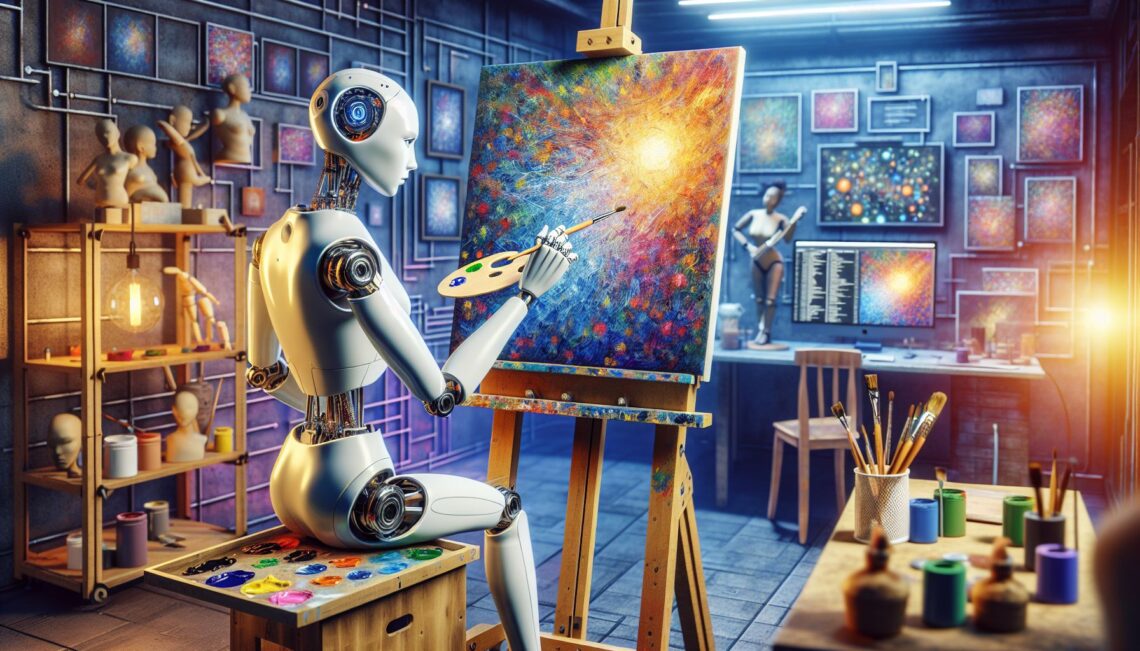
Okay, the big question: Can machines actually create meaningful art? Spoiler alert—yes, they can, and they’re getting pretty good at it. You’ve probably heard of Generative Adversarial Networks, or GANs for short. These aren’t just some arcane piece of tech jargon; they’re the brains behind AI-generated artworks. Imagine them as a pair of dueling artists—one creates, the other critiques, iterating endlessly until something jaw-dropping emerges.
Remember when that piece by the AI collective Obvious, titled “Edmond de Belamy,” sold at Christie’s for a cool $432,500? That’s GAN in action right there. I mean, who would’ve thought some lines of code would end up trumping human artists in a major auction house? If this sounds like a sci-fi spectacle to you, you’re not alone.
The Symphony of Algorithms
Besides paint and pixels, AI’s also composing symphonies. Ever heard of AIVA? This algorithm, also known as Artificial Intelligence Virtual Artist, is making waves by crafting original musical scores. Imagine an AI writing music that’s gripping enough to hit the big time. We’re seeing a future where music created by machines could become as indispensable as tracks from your favorite artists on Spotify.
Let’s take a moment to consider Jukedeck, a startup that lets users generate royalty-free music via AI. This could be a game-changer for content creators everywhere looking for unique soundtracks without the legal fuss. Who knows, maybe the next Grammy-winning tune won’t be born in a human mind, but in a server room.
AI Writing: From Typing to Tantalizing
Now, turning to words—imagine an AI penning a short story or novel that keeps you riveted. OpenAI’s GPT-3, for instance, is catching our imaginations. It writes essays, poetry, and even chatters with you like a digital confidant. I gave it a whirl trying to co-author a short story, and the results were… intriguing, to say the least. Sure, it occasionally strayed into odd tangents, but you know what? Even humans do.
While AI isn’t about to take home a Pulitzer just yet, it’s getting closer to capturing our cultural nuances. The potential here is huge—think personalized content crafted at scale, or the ability for authors to explore new creative dimensions.
The Ethical Canvas
As exciting as AI in the arts is, it opens up a can of ethical worms. One crucial question is: Who owns the rights to AI-generated art? How do we credit a machine co-creator? It’s not just philosophical hand-wringing—platforms and companies are grappling with it right now.
And then there’s the culture aspect. With machines mastering art forms humans have honed for millennia, what’s left for us? A pinch of existential dread mixes with excitement, but deep down, I believe the two can coexist. Art, after all, is as much about the creator as it is the creation. Maybe AI can push us to re-evaluate what we value in art, challenging us to be even greater.
The Future: Plots and Potential
Peering into the future, I wouldn’t be surprised if AI becomes as essential in the creative space as Adobe Photoshop or Logic Pro. Consider AI as the ultimate collaborator—able to generate ideas and mimic styles but with unlimited output and zero writer’s block. We might even see entirely new genres and styles of art that no human would have conceived on their own.
But let’s get speculative for a sec: what if AI learns to understand context and emotion as we do? Imagine an algorithm knowing exactly how to make your heart skip a beat, not just through statistical patterning but by genuinely “knowing” what moves humanity.
Wrapping It Up
So, are you pumped about AI shaking things up in the creative world, or does the thought make you uneasy? Personally, I’m all jazzed up. While technology shouldn’t replace us, it sure is amazing to see how it can elevate the arts to new heights and deeper meanings. Behind every binary command, there’s a chance for something beyond our wildest tech dreams.
Until next time, keep your mind open and your imagination in high gear. Who knows what the next pixel-pushing, chord-smashing, word-spinning AI might come up with? Whatever it is, you can bet it’ll make waves—with humans and machines collaborating in a brave new artistic future. Cheers!