Unlocking the Future: The AI Renaissance in Creative Arts
Hey there, fellow tech aficionados! Today, I’m super stoked to dive into the wondrous world where art meets Artificial Intelligence. Imagine Van Gogh painting the vibrant curves of “Starry Night” by himself—or with a little help from a neural network. We are living in this eccentric, mutual partnership between AI and creativity, and it’s nothing short of a modern-day Renaissance.
A Brushstroke of Code: How AI is Transforming Art
Alright, let’s unpack this. The creative process has always been a realm we humans thought we firmly owned. Artists get struck by a muse, pour their soul into a work, and voila—an emotional avalanche on canvas. But get this, AI isn’t just mixing mundane paint-by-numbers kits for us. It’s learning, adapting, and, dare I say, creating its own masterpieces.
The Building Blocks: Machine Learning Meets Canvas
Here’s the techy bit in a nutshell: AI systems like GANs (Generative Adversarial Networks) or neural networks are the Picasso of today’s software. They can analyze heaps of existing art, pick up on trends, themes, and stylistic elements, and then go on to make original pieces. You might’ve heard about DeepArt, Artbreeder, or DALL-E—yep, those are our cyber-artists at work!
What’s cool is that these systems don’t just replicate old mediums. They allow for the creation of entirely new styles. Remember when artists got inspired by psychedelics in the ’60s? Think of this as the digital version. Although, complete with less tie-dye and a lot more code.
Beyond the Canvas: Other Art Forms Embracing AI
Now, don’t limit yourself to just painting or visual art. AI’s a jack-of-all-trades when it comes to creativity. In music, artists can leverage AI to compose symphonies. Take AIVA, for example—it’s composing original music that’d make Beethoven nod in appreciation. In literature, tools like GPT-3 (shoutout to OpenAI!) are helping writers brainstorm plots or dialogue. Even architects are stepping into this brave new world, using AI to create innovative designs.
The Good, The Bad, and The Robotic: Debating AI-Generated Art
We’ve got to talk about the elephant—or shall I say, the robot— in the art gallery. While many celebrate this high-tech revolution, there are, of course, skeptics who fear the rise of the machines. But hey, what’s an innovation without a bit of controversy?
The Magic of Collaboration
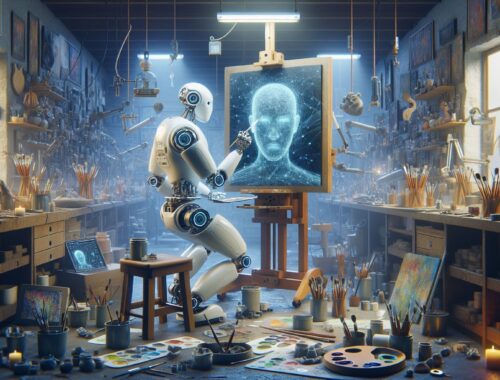
Let’s highlight the positives first. AI as a tool for artists is like giving a painter extra colors—imagine an infinite palette! Artists can collaborate with AI to expand their creative horizons. They input parameters, the AI learns from heaps of data, and together they can redefine what’s possible in art.
One prime example is the collaboration between artist Refik Anadol and AI. This dynamic duo created immersive installations like ‘Machine Hallucinations,’ where viewers swim through mesmerizing visuals beautifully rendered by an algorithm. It’s like stepping into a digital dream.
Human Touch vs. Machine Precision
But then there’s the other side of the coin. Critics argue that too much reliance on AI might dilute the authenticity or emotional depth of the art. You might say, “Well, robots don’t have feelings, do they?” That’s a solid point. There’s something inherently human in the spontaneous burst of emotions that go into creating art.
However, let’s be real, the ongoing discussion about AI art’s value and the relationship with cultural legitimacy is a bit overdramatized. Removing the dystopian lens for a second: AI isn’t replacing artists—it’s augmenting their abilities, allowing them to explore uncharted territories, faster and smarter.
The Future: Limitless Possibilities or SkyNet Art Gallery?
So, what does the future look like? Buckle up, because the ride’s just getting started. In a few years, art born from AI collaboration could become even more personal, reflecting not just general styles, but individual taste and emotion. Imagine software that understands your artistic sensibility and crafts something tailor-made just for you. Crazy, right?
Challenges on the Horizon
Of course, there are challenges. For one, there’s the question of copyright. What happens if an AI borrows from existing works and ends up in murky legal waters? Then there’s the issue of accessibility: This high-tech playground can be intimidating and might not be easily navigable for everyone, especially those without technical grounding.
An Optimistic Outlook
Here’s my take on it: Embrace the change. Instead of fearing the rise of robo-artists, let’s marvel at what humans and machines can create together. Whether you’re an artist or just an admirer, there’s a brave new world to explore. I, for one, am pumped to see where this fusion of creativity and code will take us.
In conclusion, AI is redefining creatives in compelling ways, blurring the boundaries between man and machine. Let’s weave them both into the vibrant tapestry of what we call art. After all, in this digital Renaissance, who knows what masterpieces await?
Until next time, keep innovating, stay curious, and maybe consider picking up a robot to co-design your next masterpiece. Cheers, friends!