The Rise of AI in Creative Arts: A Brush with the Future
Hey there, fellow tech enthusiasts! Today, I want to dive into a topic that gets me practically buzzing with excitement—and let’s face it, more than a little awe. We’re talking AI and its blooming relationship with the creative arts. You might wonder what on earth algorithms and canvas have to do with one another, but if you hang tight, you’ll discover that they’re becoming quite the dynamic duo. From generating art to composing symphonies, AI is proving that it’s not just for crunching numbers or managing data. It’s also doing impressions of Da Vinci, Shakespeare, and Mozart, all at once!
The Advent of AI Artists
When we think of art, we traditionally think of that human touch—that inexplicable quality of emotion and lived experience. But now, machines are dipping their toes in paints and pixels, too. Take DALL-E, for instance—OpenAI’s neural network that can create astonishingly intricate images from textual prompts. I once tried throwing random phrases like “a futuristic city floating above a vivid coral reef” at it, and the results were… well, let’s just say mind-blowing. It’s like asking Picasso to scribble something for you in a coffee shop, and getting a masterpiece in return.
We’re also seeing platforms like Artbreeder pushing the envelope, allowing users to ‘breed’ new images from existing ones. The human role? You guide the genesis of each new picture through successive iterations, like a mix between George Jetson and Andy Warhol.
AI Composers: The Beethoven of Bots
Don’t even get me started on music. AI isn’t just creating visuals; it’s venturing into soundscapes and symphonies. Companies like AIVA (Artificial Intelligence Virtual Artist) are crafting entire pieces of music, ranging from ambient to classical, all with the help of algorithms. How does it work? Essentially, the AI analyzes thousands of classical compositions and learns the patterns that make Beethoven, well, sound like Beethoven. Then it crafts its own pieces, sometimes so convincingly that you’d swear they were penned by someone with a stuffy cravat and a quill.
Of course, this raises the question—if an AI can make music as good as Bach, what role do human composers play? I like to think of it as a collaboration. Musicians can leverage AI-generated pieces as inspiration, remix them, or even perform them live. It’s a new world where Bach and Bitrate coexist harmoniously.
The Implications for Human Creativity
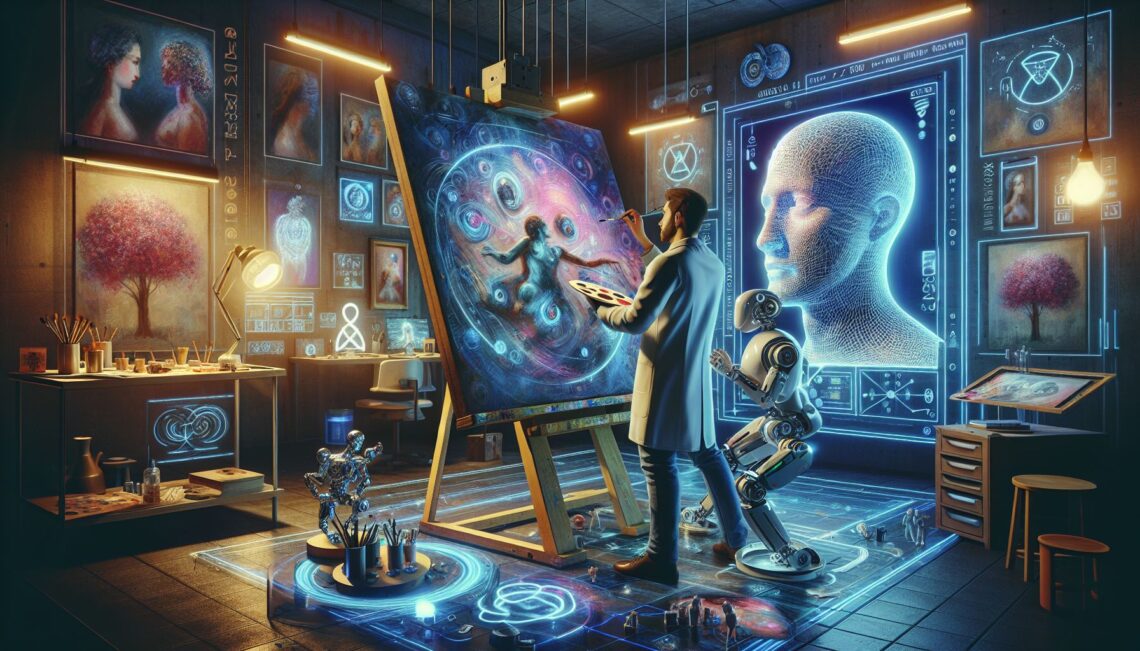
So what’s the game plan here? Are we all out of a job? Thankfully, no. The rise of AI in creative fields doesn’t mean it’s time to pack up our easels and instruments. On the contrary, it presents opportunities for collaboration, where human intuition meets machine learning. I like to think of AI as a new set of tools and brushes for artists to play with, expanding what’s possible rather than replacing the human element.
AI can free us from some of the drudgery that often accompanies the creative process—imagine being able to outsource the mundane task of tuning samples or rendering drafts. That leaves us more time to focus on what we do best: innovating, dreaming up new ideas, and giving those ideas a personal spin.
Challenges and Ethical Quandaries
But wait—there are hurdles to cross on this motorway to innovation bliss. First off, issues surrounding copyright and ownership are going to spark intense debates. Who owns an AI-generated piece of art? The developer of the algorithm, the user, or some combination thereof? As a digital nomad who sometimes dabbles in content creation, it’s something that’s caused me a fair bit of existential pondering.
And let’s not overlook the potential for bias. An AI’s output is only as unbiased as the data it’s trained on. If the input dataset favors certain styles or cultural elements over others, it could inadvertently reinforce those biases. We need oversight and thoughtful consideration to nip these kinds of issues in the bud.
What’s on the Horizon
Looking forward, the potential here is as exciting as it is vast. I predict we’ll see AI evolve into ever more sophisticated versions of itself, creating art that continues to surprise and challenge us. More artists will tap into this burgeoning toolkit, and we might well see new genres and styles emerge that we hadn’t even conceptualized.
Imagine AI-generated art installations in pop-up galleries or symphonies that change in real-time based on audience feedback. I’d love to attend an opera or theater performance where some elements adapt dynamically to engage the audience—even if it’s just to find the perfect moment for comic relief (I mean, think of the potential for AI-generated slapstick!).
Conclusion
In the end, AI’s role in the creative arts won’t be about overthrowing human creativity but amplifying it. If we view this transformative technology as a partner rather than a rival, a whole new world of creativity opens up. So, let’s get inspired and maybe a bit playful too. We might just end up creating the kind of art that sets future algorithms and artists agog—for all the right reasons.
Until next time, keep those creative juices and bytes flowing!