Welcome to the Age of Robo-Artists: AI and the Creative Revolution
Hello Artists and Tech Enthusiasts!
Have you ever sat at an art museum, sipping your coffee and wondered, “What if the next Van Gogh isn’t human?” No? Just me? Well, buckle up because the landscape of creative arts is changing faster than you can say “Starry Night,” and it’s all thanks to Artificial Intelligence.
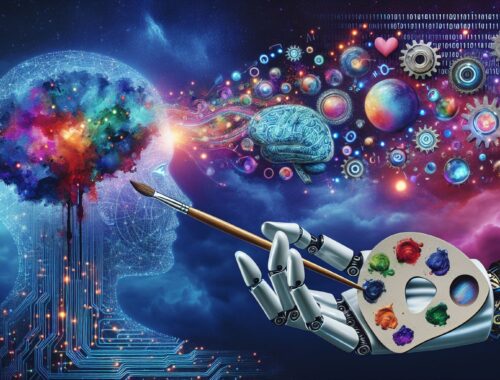
From creating paintings to composing symphonies, AI is not just dipping its toes in the artistic pond. It’s diving in headfirst, and, honestly, it’s making some pretty impressive splashes.
AI as the New Renaissance Artist
Now, I know what you might be thinking: “AI making art? Really?” But look, today’s AI isn’t like the clunky programs from sci-fi movies. The recent boom in machine learning and data processing has given us AI that can, quite literally, create a masterpiece.
Take, for example, OpenAI’s DALL-E 2. This program can generate detailed and vibrant images from mere text descriptions. Want an image of a two-headed flamingo balancing on a rainbow? Boom. DALL-E’s got you covered. It’s part genius, part magic trick.
The capabilities are mind-bending. I tried feeding it a quirky prompt just for kicks, something like “A steampunk pirate ship sailing through a cloud made of marshmallows” (because why not?) and was blown away by how the AI translated abstract imagination into a visible narrative. It’s like having your own personal Da Vinci who works on caffeine and algorithms.
Why AI Now?
So, why is this happening now? Two words: Big Data. Okay, that and exponential tech advancement. We’ve reached a point where the computational power available can process enormous amounts of data. This allows AI to learn patterns, styles, and techniques from a vast array of existing art. It’s like sending them to art school, except they binge-learn everything overnight.
Companies like DeepMind and NVIDIA are at the forefront, offering tools that give artists supercharged creative wings. They’re letting machines crunch pixel data while human artists direct the creative vision, a team-up Batman and Robin wish they had.
Bridging the Gap Between Tech and Human Artistry
Now, while AI art evokes awe and some eyebrow raises, a key question emerges: Where does human creativity fit into all this? Are we destined to become sidekicks to our silicon counterparts? I’d say the opposite.
AI in the creative arts is a tool, not a replacement. Think of it as Photoshop on steroids. Artists today are using AI to enhance, not overtake their creative process. The same way a digital artist might use a graphics tablet, traditional artists can experiment with AI as a medium itself.
One of my artist friends decided to collaborate with AI on a project. Her results were a bewildering blend of traditional oil strokes with AI-generated patterns, creating a synergy that was vibrant—a kaleidoscope of human emotion and digital precision. She said that AI was like an unpredictable but exciting dance partner, keeping her on her artistic toes.
Challenges on the Horizon
Alright, time to play devil’s advocate for a second: There are a few challenges. The big one? Authenticity. In a world where machines generate art, distinguishing between a human artist’s vision and an algorithm’s output can get tricky. How do galleries value an AI-created piece? To be honest, it feels like a puzzle from one of those escape rooms. Complex and full of surprises.
Then, there’s the tricky terrain of copyright. Who actually owns AI-created art? Is it the programmer, the user, the AI itself? Legal minds are scratching their heads, and this conversation might need a whole series of its own.
Ethically, we also must ask how much control we want to hand over to machines in creative decision-making. The essence of art is human expression, after all. As my skeptical-but-intrigued uncle always says, “Let’s not let machines hustle us out of Bob Ross-level serenity.”
The Future of Creative Coexistence
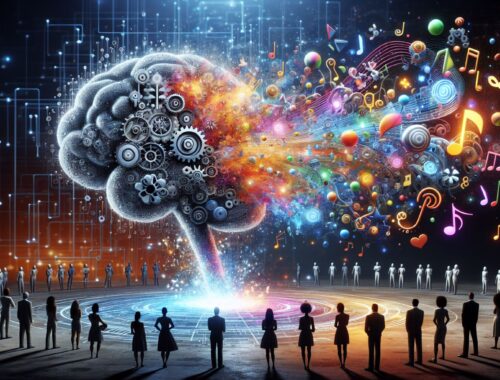
In the near future, I imagine a hybrid art community where artists and AI work hand in hand (or circuit), pushing the boundaries of what’s visually conceivable. Maybe we’ll see a rise of AI curators or galleries dedicated entirely to algorithm-crafted works.
Just imagine an Art Basil 2030 with AI artists showcasing wild creations while humans sip their lattes and gawk at the inventiveness. Or the advent of AI collaboratives that combine cultural aesthetics from around the globe synthesizing novel styles.
So, What’s Next?
Look, no one’s denying that this tech revolution is a wild ride. We might wrangle with some thorny questions along the way, but isn’t that what adventure’s all about? So here’s to the artists, both flesh and cyber. Together, they’ll redefine what art can be.
In the meantime, whether you’re a painter or a digital native, I say stay curious. Because, who knows? Your next gallery visit might just have you admiring the artistic genius of a computer program—and maybe, just maybe, you won’t mind too much.
As for me? I’m off to see if I can get my AI to finally understand “Mona Lisa in flip-flops.” It’s a work in progress but, hey, so was the Sistine Chapel. Until next time!