The Rise of AI in Creative Arts: Painting the Future with Algorithms
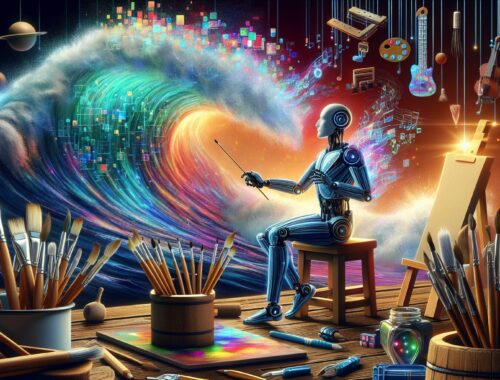
Hey there, fellow tech enthusiasts! Today, we’re diving into a realm where the seemingly calculated and logical world of Artificial Intelligence intersects with the wondrous and unpredictable domain of the creative arts. Yes, you heard it right. We’re watching AI brush strokes on digital canvases, compose symphonies, and even write screenplays. It’s like witnessing a robot Picasso or an algorithmic Mozart at work. And let me tell you, it’s as fascinating as it sounds.
A Brief Canvas of History
Before we delve deep, let’s take a quick stroll down memory lane. Remember Clippy, Microsoft’s quirky Office Assistant? He was one of the earliest examples of AI dabbling in human-centric tasks—though not very creatively, unless you count his suggestive dialogue boxes as avant-garde prose. Fast forward to the present day, and AI systems are not just assisting but actually creating art.
The evolution from Clippy to today’s creative AIs sort of reminds me of the time I upgraded my 90s dial-up internet to fiber-optic broadband. Suddenly, everything was faster, more efficient, and surprisingly capable of things I couldn’t even imagine at the time.
AI Gets Artsy
Painting and Visual Arts
The artistic journey began with AI training on massive datasets of famous artworks. One of the early breakthroughs was with Google’s DeepDream project. It used neural networks to detect patterns and create hallucinogenic, dream-like images. Imagine mixing Salvador Dalí with a hyperactive splash of a kaleidoscope—truly mesmerizing, if not mind-boggling.
Then came GANs (Generative Adversarial Networks), which took it up a notch. Think of GANs as competitive siblings: one generates art (the “artist”) while the other critiques it (the “critic”), continually pushing each other to improve. This isn’t just fascinating technology; it’s like watching a friendly neighborhood rivalry but in code form.
I remember trying my hand at painting once and creating a modern art masterpiece—well, my mom thought it was a masterpiece, but my art teacher called it “interesting.” With AI, even my monitor now seems to be outpainting me.
Music and AI: Groove with the Machine
Music has seen a symphonic transformation as AI began composing intricate rhythms and melodies. Platforms like OpenAI’s Jukebox are not just remixing existing songs but generating novel compositions in the style of any artist you can think of. It’s kind of like having your custom Spotify playlist generated on-the-fly by an incorporeal DJ.
I recently asked an AI to compose a piece inspired by my favorite indie band. The result was stunning. While my futile attempts to learn the guitar ended after the first two chords, my virtual assistant here was producing melodies that managed to convey a heartbeat of nostalgia wrapped in futuristic vibes.
Screenwriting and Storytelling
The world of storytelling hasn’t escaped the transformative touch of AI either. Bots are now writing short stories and screenplays, with some even making their way to public readings and film festivals. While I wouldn’t be inclined to hand over my Oscar dreams to an AI just yet, the creativity bubbling from these digital pens is undeniably exciting.
One interesting snippet I chanced upon was a science fiction short film crafted entirely by AI. The dialogues were quirky fit for a low-budget sci-fi comedy, much like my school drama performances. Yet, they were infused with a captivating sense of originality.
Why Should We Care?
So, why does this matter? Sure, AI’s ability to create art is impressive, but it’s more than just fancy tech. It’s reshaping our understanding of creativity itself. Traditionally, creativity was seen as the ultimate human trait, guided by emotions, experiences, and imagination. But now, AI is challenging that notion, prompting creative professionals and techies alike to rethink what it means to be an artist.
For traditional artists, AI can become a collaborative tool. Imagine designing a mural with your laptop as a co-painter or having a song’s melody crafted by an AI that you can then refine and perfect. It’s like having a sidekick who does the heavy lifting while you finesse the details. If only my vacuum cleaner could help me clean—and not try to eat my socks in the process.
Challenges and Ethical Debates
Like with any groundbreaking technology, there are challenges we must navigate. One major concern is authenticity. Can an AI-generated piece hold the same emotional depth as something created from human experience? Can algorithms experience an artist’s block or go through an existential crisis, like us mere mortals? I had an existential crisis once when I lost my Wi-Fi signal.
Moreover, who owns the rights to AI-generated art? The creator? The programmer? The software company? It’s a tangled web that echoes the complex copyright battles of our digital age.
Looking to the Future
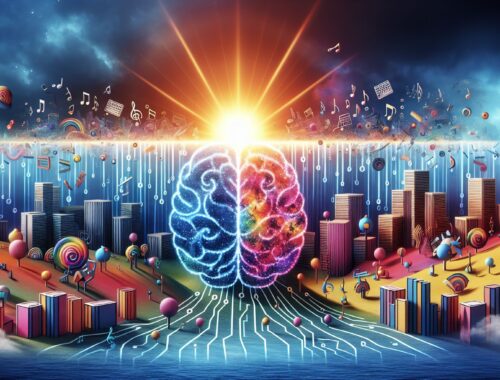
As we look ahead, one thing is certain: the canvas of creativity is expanding beyond our wildest imaginations. AI will continue to blur the boundaries between man and machine, pushing us towards an era where creativity knows no bounds, only potential.
In this techno-utopian vision, artists may end up cherishing their algorithmic companions, much like one would a pet—a misunderstood pet that occasionally churns out a bestseller while you’re off watching cat videos online.
To wrap it all up, the fusion of AI and the creative arts is here to stay, evolving and challenging our perceptions. It’s a thrilling frontier, and I, for one, am all in. I’ll just have to keep an eye on my laptop to make sure it doesn’t decide to start its art exhibit. Who knew watching a computer work could be so inspiring?
So, grab your favorite beverage, pull up a chair, and witness the future of creativity unfold. And hey, maybe you’ll find inspiration for your own next masterpiece—electrons and pixels are waiting to be your muse!